
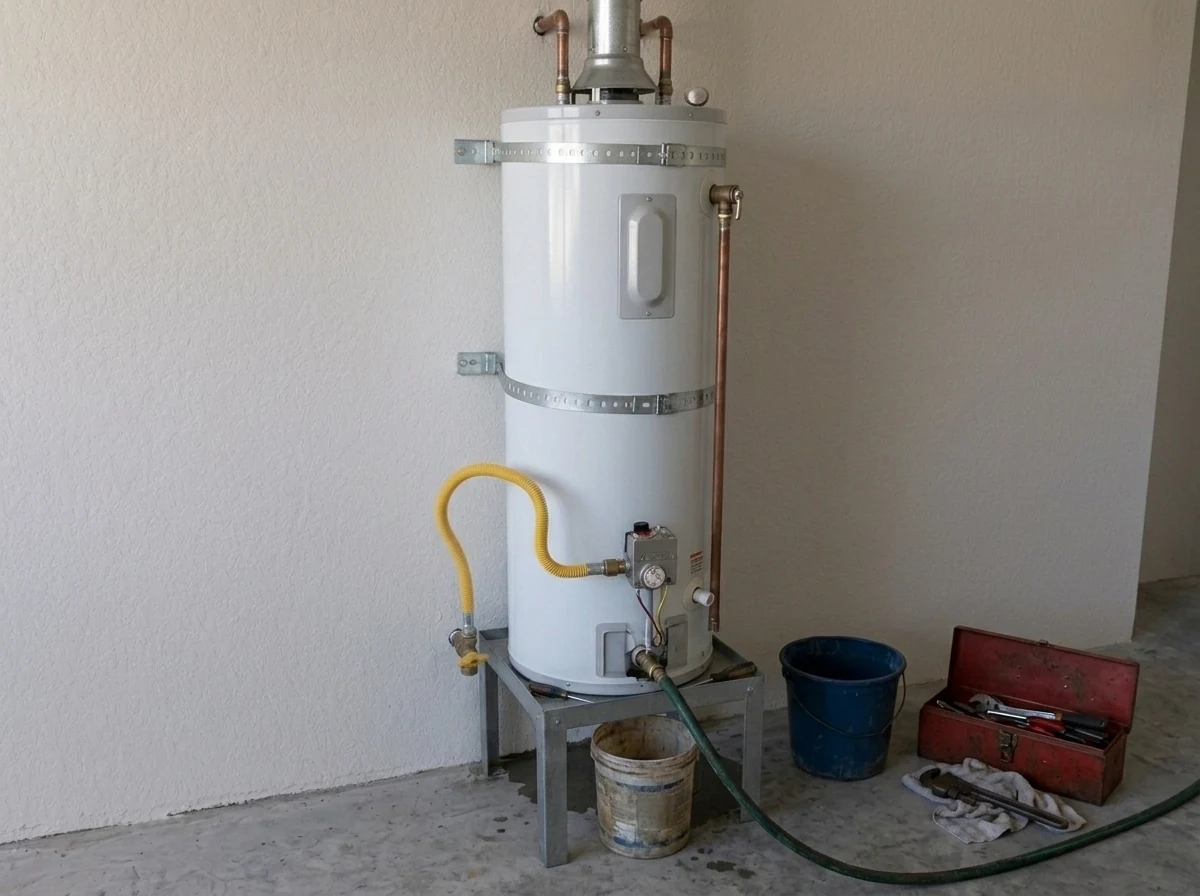
What Is Water Heater Maintenance?
Water heater maintenance is routine care that helps a tank water heater run safely and last. It covers the temperature setting, sediment, the anode rod, the pressure relief valve and insulation. Most storage water heaters last 10–15 years (Energy.gov).
Water Heater Maintenance Checklist
What Regular Care Covers
These tasks come from DOE, the Consumer Product Safety Commission and a DOE-sponsored review (PNNL, 2013). Follow your heater’s manual first. A PNNL review notes that lowering the temperature setting can create conditions that favor bacteria, so ask a professional what setting is right for your household if you have concerns.
- 01
Check the temperature setting. DOE considers 120°F safe for most people, and CPSC urges it to reduce scalds. Even 120°F can burn after five minutes (CPSC).
- 02
Drain sediment. DOE suggests draining a quart every 3 months. PNNL recommends a full drain about once a year where hard water leaves sediment.
- 03
Inspect the anode rod after about 3 years, then yearly (PNNL). Replace it if more than 6 inches of bare core wire shows or it is under half its original diameter. Never remove it.
- 04
Have the pressure relief valve checked. Scale can clog the pressure relief valve and the drain valve, which affects safety (PNNL). Ask the professional to test it.
- 05
Insulate where it helps. If the tank is warm to the touch, DOE says insulating it can save 7%–16% a year. Insulating hot water pipes can save another 3%–4%.
- 06
Know your heater’s age. Check the manufacture date on the rating label. At 10–15 years, ask about replacement.
4-Step Process: Water Heater Maintenance
RapidHeat Stockton connects you with a local professional, who sets the price.
Call and Connect
Call (209) 528-0498. We take your address and what you want checked, then connect you with a local professional.
Inspection
The professional checks the temperature setting, sediment, the anode rod, the pressure relief valve and the connections.
Written Quote
Ask for a written quote that itemizes the work (a flush, an anode rod or a valve) and the price. The professional sets the price and terms.
Visit and Final Check
If you accept, the professional does the work. Ask what they found and when the anode rod should be inspected next, and keep the quote and notes.
Key Cost Drivers: Water Heater Maintenance
The professional sets the price after inspecting the unit. Ask for each factor in writing.
Scope of work
A flush, an anode rod replacement and a valve replacement are different jobs. Ask for each one itemized.
Heater type and age
Gas, electric and tankless units need different care, and older units may need more.
Water quality
Hard water leaves more sediment. Soft or softened water wears the anode rod faster (PNNL).
Access and condition
Where the heater sits and how easily the drain valve and anode rod can be reached change the work.
Maintenance Schedule at a Glance
If you have a salt-based water softener, PNNL says softened water speeds anode wear and recommends yearly anode inspection, and suggests considering a non-salt softener. Hot water and gas can cause injury. Follow your manual, and if you smell gas, leave the building and call 911 first.
Water Heater Maintenance FAQs
Short answers to common questions about water heater maintenance in Stockton, CA.
CPSC urges 120°F, and DOE considers it safe for most of the population. If you adjust it yourself, follow your manual. Check the result with a thermometer at the faucet.
Most adults suffer third-degree burns after two seconds at 150°F, six seconds at 140°F and 30 seconds at 130°F, and even 120°F can burn after five minutes (CPSC).
DOE suggests draining about a quart every 3 months to remove sediment. A DOE-sponsored review (PNNL) recommends a full drain about once a year where hard water leaves sediment. Check your manual for your unit’s schedule.
After about 3 years, then yearly (PNNL). If your water is soft or you use a softener, check it yearly from the start. Replace it if more than 6 inches of bare core wire shows or it has corroded to less than half its diameter. Do not remove it.
Yes. Heavy sediment can overheat the bottom of a gas tank and eventually cause it to fail. On an electric tank, sediment that buries the lower element can make it overheat. Regular flushing helps prevent both (PNNL).
If the tank is warm to the touch, DOE says insulating it can save 7%–16% a year, and insulating hot water pipes can save another 3%–4%. Follow the manufacturer’s recommendations.
Yes. PNNL says softened water speeds anode consumption and recommends yearly anode inspection, and suggests considering a non-salt softener.
The professional sets the price and terms. Ask for a written, itemized quote and read it before you agree. Also ask for their California contractor license number and check it with the Contractors State License Board.
Call Our Phone Line
Serving homeowners in Stockton, CA. Our phone line is open Mon–Fri 8AM–6PM and Sat 9AM–2PM.
7805 Brentwood Dr, Stockton, CA 95207, USA
Mon–Fri 8AM–6PM | Sat 9AM–2PM
Stockton, California